A Taste of Asturias, at This Moment in Time
- Kim Merritt
- Jun 16
- 7 min read

I’ve followed Alejo Sabugo many places on Roads & Kingdoms trips, some more questionable than others. Whether we’ve ended up on a hidden trail, an Italian Prince’s palace, or a windowless basement for a five-star private dining experience, there’s always a memorable story at the end.
This time we were in Asturias, the place Alejo calls home, trekking uphill in the Picos de Europa behind Jose, a cheesemonger in his seventies who navigates the terrain better than those of us in our 40s. We followed the path Jose takes daily in his work, crushing thorny brush under each step, before reaching a small metal gate embedded into the limestone. Jose unlocked the gate and gestured for us to follow him down into complete darkness. Lured by the pungent, all-encompassing smell of aging Gamonéu cheese, we descended by the light of our headlamps, underneath stalagmites stretching from the ceilings above.


Then it appeared: a turophile’s utopia. Rows of cheese, aging to perfection. Jose immediately began his duties tending to each wheel, unwrapping sheets of paper, dusting rinds, and checking for mites, while we learned all about the process happening within these unique cheese caves. While the cheese is made at farms in the villages of the valleys below, it makes its way up to these caves to age for 2-3 months. These caves are completely unique to this region, providing the perfect environment for aging types of Gamonéu and blue cheese that cannot be replicated anywhere else in the world.
After learning all about the aging process, we climbed back up to enjoy our spoils in the light of day—cheese and bread in one hand, a paper cup of red wine in the other, the ultimate reward for this luxurious version of hunting and gathering. I couldn’t help but notice the look on Jose’s face as he rested on the hillside. He looked tired. Friendly and warm, but exhausted. Alejo must have noticed too, because this was when he planted the question in our minds:
“How much longer can someone of Jose's age continue to do this?”

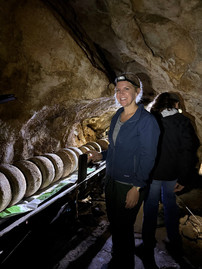


Hiking hundreds of feet each day, battling Mother Nature on the way up, and the complexities of the cheese aging process within. This process isn’t something you’ll find on Google. It’s the kind of knowledge that gets passed on by climbing the hill beside Jose. The problem is there is no one hiking beside him. Younger generations have moved to cities like Barcelona and Berlin to study, choosing white-collar career paths over old traditions, and leaving the future of cheesemaking in the caves of Asturias uncertain.
This was the first time we faced this question, but the theme rang true throughout our entire week-long trip: cultural traditions are dying in Asturias, and around the world.



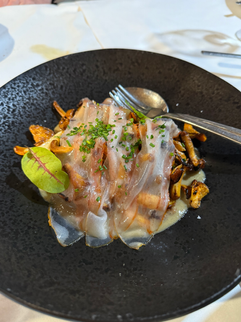

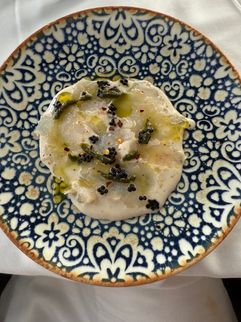


Dish after dish we explored meals and stories that connected Asturias’ present to its past: salmon with toasted corn cake and blue cheese. Celery curd with seaweed, cucumber, and sheep sorrel granita. Cider poured from the same place it was produced, perfectly aerated at arm’s length and chugged within seconds.
Asturian cuisine is traditionally rooted in ingredients that are available locally. Once upon a time, that region was confined by geography—a rocky coastline and mountains that form a natural barrier from the rest of Spain and Europe. But modernization by way of technology, transportation, and tourism has opened the region up to trade. Yet while importing and exporting have become more commonplace, the generations who leave to study and live elsewhere are quietly taking with them the future of these traditions.
Another place we saw the tension between tradition and modernization was at the commercial fish market in Puerto de Vega. From a balcony overlooking a live auction, we watched buyers from restaurants across Asturias bid on crates of fresh percebes. Percebes (aka goose barnacles) are notoriously difficult to harvest, requiring both physical fitness and cojones. Fishermen must hand-harvest these delicacies from steep, rocky cliffs during low tide by climbing onto the rocks, dodging furious waves that threaten to pull them under each time they crash. The rockier and more wild the coastline, the better the percebes, but obviously the more dangerous for those gathering them. It’s a risky job, and it’s no surprise the future of this career path feels uncertain when it’s far safer to work behind a computer than in the unforgiving waves of the Atlantic.
To give us a taste of this dying delicacy in its natural environment, we headed straight to the rocky beaches with Chef Elio Fernandez of Ferpel, for a picnic of percebes, sea urchins, and seaweed in their most natural form—paired with cider, of course.


Each stop on our week-long feast showed us a region balancing preservation and progress—places where history is still alive, even as the future slowly reshapes it.
One of those historical shifts began centuries ago with corn. Asturias was the landing place in Europe after corn made its way across the Atlantic in the 17th century. Though it arrived a bit late, it caught on quickly by feeding miners, farmers, and fishermen. We explored that history at one of the last working water mills still grinding corn flour today. Our hosts, Belen and Toño, welcomed us with our first taste of cider, and made a lasting impression with their fabada and fresh corn tortillas topped with blue cheese and honey.




This itinerary served us seven packed days of eating our way through Asturias, joining multiple Michelin-starred chefs for meals in inspiring locations—outdoors, in their homes, and in centuries-old palaces. None of it would have been possible without the kind of access Roads & Kingdoms provides. At the center of that access was very obviously Alejo, and we were the fortunate beneficiaries. Everywhere we went, every interaction, Alejo was the key to a private table or closed door. Through his career as a fixer and producer, Alejo has introduced non-locals like Anthony Bourdain and Eva Longoria—and their hundreds of thousands of viewers—to the Asturian food scene. Many of his childhood friends now run some of the region’s most iconic restaurants and food shops, which is how we found ourselves tasting anchovies at the heavily awarded Hazas—a place so committed to excellence they wouldn’t let us buy any to take home, fearing the quality would suffer in transit. And we not only got to learn all about Asturian cider at the world-famous Sidra El Gaitero, we were invited to the Collada family’s home to make our own.


Having Alejo’s perspective as the backdrop to our trip illustrated how cultural traditions are disappearing. At the cheese caves, many of us quickly began to imagine a life where we leave our worries behind in the U.S. to start fresh as cheesemongers in the mountains of Spain. Even Alejo entertained the fantasy. He longed for the chance to carry on the tradition of the cheese caves, but he’s also a realist. He talked through the questions many of us ask ourselves while dreaming of escapism—what about his family? What would his young daughters do? Would he expect his wife and kids to move hours away from civilization just to entertain this idea?
But not all hope for tradition is lost. Change is an inevitable part of life, and all across Asturias there’s a notable wave of chefs paying homage to their roots—the ingredients, the landscape, the rugged coastline—and transforming them into something new that has helped put Asturian cuisine on the global map.
Perhaps the most obvious example of this is Chef Nacho Manzano, who has earned three Michelin stars by elevating the high-altitude cuisine of his native land at Casa Marcial. With dishes appearing on the menu as “Memories-humidity-ferns-fresh water” and “Destruction-childhood-emotion-intrigue-event,” dining in this rustic farmhouse turned white-tablecloth restaurant offers a deeply personal interpretation of Asturian flavors drawn from the rugged farmland and powerful sea.




Then there’s Chef Mariano Mier of Yanik, who brings his international culinary experience to reimagine Asturian ingredients in unexpected ways. During a private dinner with him at Palacio de Figueras, I tasted one of my favorite bites of the entire trip—a sort of tuna ceviche served on a slice of lime, topped with pop rocks (yes, the candy). It was truly unique and memorable, because that single bite has cemented a place in my brain for months now.


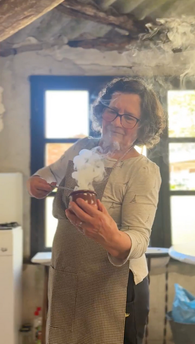
This new generation of Asturian chefs are going beyond food and creating entirely new kinds of experiences, too. We visited Historias de Tierra, the studio and home of Valle García, a woman whose ceramics are used in some of Spain’s top kitchens. There we learned to make pottery that perfectly complements Asturian cuisine, by pulling minerals and clays directly from the local hills and shaping them by hand. Once finished, García’s partner, Chef Andrés Madrigal, creates multi-course meals, each inspired by the dish it's served on. The result is a fully immersive culinary experience: we created the dishes with our own hands, then sat down to eat a meal inspired by everything around us while sipping wine and looking out over the city of Gijón.


After this week-long culinary experience that felt a lot like living journalism, I couldn’t help but wonder: will Gamonéu cheese one day disappear? Will percebes still be harvested from those cliffs, or will the danger eventually outweigh the reward? Only time will tell. But for now, they still exist. Jose is still hiking that hill every day, unlocking the metal gate and wandering down into the cave. Fishermen are still timing the tides and climbing out onto jagged rocks, hoping the next wave doesn’t pull them in. And the new-age chefs will continue experimenting with new ways to breathe life into traditional ingredients.
The future of food in Asturias will continue to evolve. But for one week, I was lucky enough to see it as it is right now. I’m grateful to have gotten a taste of this moment in time, because as we all know, moments like these don’t last forever.


